Why Gardening? It All Starts With the Bench.
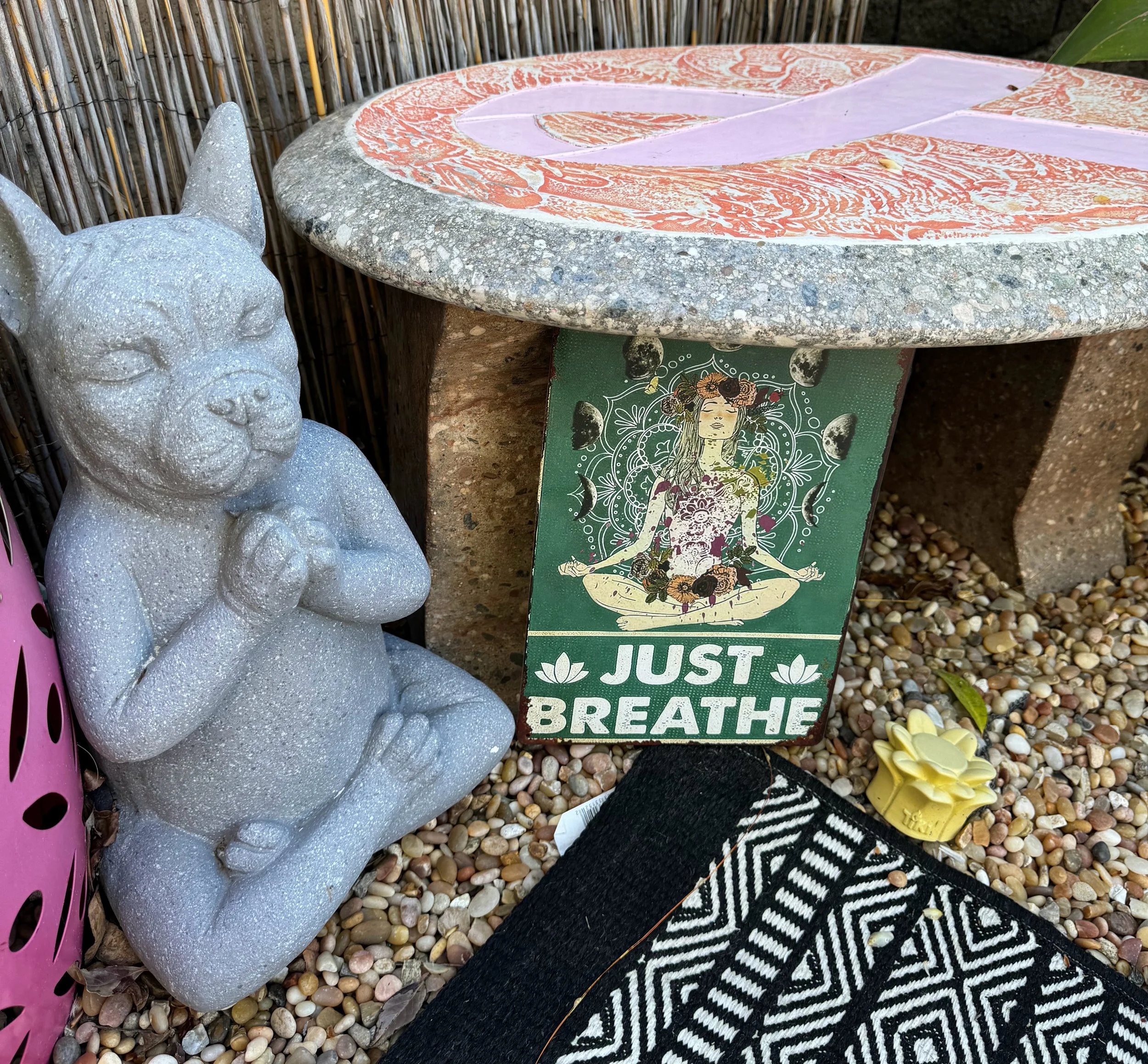
For Britany and me, it all starts with the bench.
When I met Britany, I was in a moving moment. Literally. Our landlord had decided to kick us out in favor of a cousin, so I was hauling plants across town and haphazardly stacking our new driveway with things I had hastily dug out of the previous yard. Yes, I was a renter; no, I was not leaving my plants.
Plants have always “grounded” me. I know that word is suspiciously on-theme, but there it is. When the place where I lived suddenly stopped being mine, the plants were living pieces of continuity I could carry.
Along came Britany with her big Britany voice, asking about my plants as though a driveway full of uprooted greenery was a perfectly reasonable way to introduce oneself. I headed over to her house, happy to have met a neighbor, and there—in the place of honor in her garden—was a concrete bench marked with a breast cancer ribbon.
The bench told me something before Britany had to explain it: cancer had been there, survivorship was still living there, and the garden had made room for both.
Backyard Breasties did not have a name, a mission statement, or any of the paperwork required to turn care into an organization. We had displaced plants, Britany’s voice traveling farther than ordinary indoor voices are legally allowed to travel, and that bench.
The bench came first.
Why five minutes counts
Cancer and the survivorship that follows arrive no matter what kind of moment a person is already living through. Cancer does not wait for the move to be finished, the children to be older, or the garden to look presentable. It enters a life already in progress and rearranges the available time, strength, attention, and certainty.
That is one reason “gardening is good for you” can be such spectacularly unhelpful advice.
Gardening can sound like a project: build the beds, haul the soil, weed the yard, install the irrigation, and become the kind of person who owns a sun hat without immediately losing it. During treatment or survivorship, even something you love can become one more assignment you are supposedly failing.
We had displaced plants, Britany’s voice traveling farther than ordinary indoor voices are legally allowed to travel, and that bench. You can read more about how Backyard Breasties began.
Research Rabbit Hole
Here is what I found, what I think it may mean, and—equally important—what the research does not prove.
Cancer-related fatigue is not the same thing as staying up too late. It can interfere with ordinary activities and concentration. The American Society of Clinical Oncology’s 2024 guideline on fatigue in adult cancer survivors recommends exercise as one of several evidence-based approaches that can help reduce fatigue. That does not mean every survivor should be handed the same exercise plan, or that gardening is automatically safe on every treatment day.
A 2018 home-based, mentored vegetable-gardening intervention among breast cancer survivors found that the program was feasible and reported improvements in physical activity and performance. It was a structured intervention with support—not proof that everybody should be sent outside with a shovel and a motivational quote.
Neither source establishes five minutes as a medically meaningful dose. Five minutes is not a prescription hiding in a clinical guideline. It is permission to keep the garden door open when energy, heat, pain, nausea, mobility, or human bandwidth makes a larger plan ridiculous.
The research gives us reasons to take movement and garden participation seriously. It does not give us permission to ignore the individual body, treatment plan, or care team.
The Southern California version
It is late July in Southern California, which means the garden may also be declining an ambitious assignment. The UC Master Gardeners of Ventura County call June and July the slow season for many California native gardens. Conditions vary sharply: the coast can be cold and drizzly while the eastern side is blazing hot. Apparently even our weather refuses to use one treatment plan.
This is not the moment to turn a five-minute practice into a noon endurance event. Depending on the person, the garden, the weather, and the care team’s guidance, five minutes might look like:
- sitting on the bench and noticing what changed;
- checking one drip emitter for a wet or dry patch;
- clipping one spent flower;
- photographing a plant problem to investigate later; or
- telling a willing helper exactly which heavy thing needs to move and where.
If somebody else waters, lifts, digs, or hauls, it is still your garden. Agency does not require doing every job with your own hands.
Back to the bench
That concrete bench changed the question for me. I stopped thinking only about what a garden could produce and noticed what it could hold: memory, interruption, rest, beauty, anger, conversation, and two neighbors who did not yet know they were building something together.
Fact is, gardening connects us.
If you are a Breastie, your five-minute garden appointment can be sitting down. If your plants or pets need more than you can give during treatment, you can request free plant care and pet-sitting support.
Sometimes gardening connects us before we know what we are building. For Britany and me, it began with a driveway full of uprooted plants, a voice too big to ignore, and a concrete bench that was already telling the truth.
Sources
- Management of Fatigue in Adult Survivors of Cancer: ASCO–Society for Integrative Oncology Guideline Update
- A home-based mentored vegetable gardening intervention among breast cancer survivors
- National Cancer Institute: Fatigue (PDQ®)–Patient Version
- UC Master Gardeners of Ventura County: Monthly Checklist—June/July 2026